Analysis
Analyse your infrastructure to make data-driven decisions
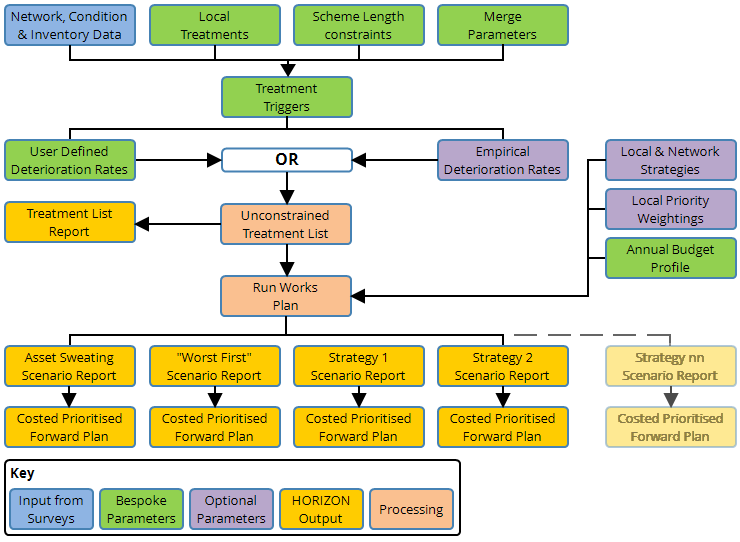
Use the Analysis module to model and strategise asset maintenance across your Network for the years ahead. From real survey data, predict how each asset type will deteriorate, identify effective Treatments, and apply financial constraints and strategic targets to produce cost-effective, multi-year maintenance programmes.
Start by configuring your analytical foundation. Group assets by shared characteristics, define the condition metrics captured in surveys, and then set deterioration curves to predict how each group will change over time (using historic data or your own equations). Give optional weighting to local priorities such as accident hotspots.
Use the Analysis Tools to define a library of Treatments, organise them into hierarchical Treatment Sets with trigger rules, and specify budgets across financial years. Create a Works Plan that uses all these inputs to model multiple maintenance scenarios. Each scenario is evaluated against your strategic targets. The output is a fully justified maintenance programme, ready to explore through reports and map visualisations!
Features
In the Analysis module, use the floating toolbar to access these features.
Asset Groups
Asset Groups bring together Network assets that are expected to deteriorate in similar ways, due to shared characteristics e.g. road class, surface type, traffic load. For each group, a mean deterioration curve can be derived from real survey data, forming the basis for condition modelling and Treatment planning.
Condition Parameters
Condition Parameters are the attributes and standard metrics recorded on your assets during surveys, which track and predict condition over time, e.g. rutting depth, cracking, skid resistance. For each parameter, you can define a deterioration curve per Asset Group that models how values will degrade over time. Curves can be built from historical survey data or defined manually with a linear, quadratic or custom equation. They drive all future condition predictions and Treatment timing across your Network.
Priorities
Priorities bring non-condition data into Treatment selection, e.g. accident hotspots, flood risk, traffic volumes. Each dataset is weighted by relative importance, producing a normalised score for each asset length. A Works Plan can apply these scores to Treatment ranking, so that maintenance decisions reflect local factors alongside asset condition.
Strategies
Strategies set the targets and constraints that steer a Works Plan's Treatment selection across financial years. You can define Strategies that target industry KPIs, condition thresholds, backlog caps and emissions limits. The Works Plan will find the most affordable scenario that meets as many Strategies as possible.
Some features may be limited depending on your account access. See Users.
Contents
📄️ Asset Groups
Categorise assets by deterioration
🗃️ Condition Parameters
Define what is measured and how it degrades
📄️ Priorities
Prioritise Treatments for local factors
📄️ Strategies
Set targets for Works Plans